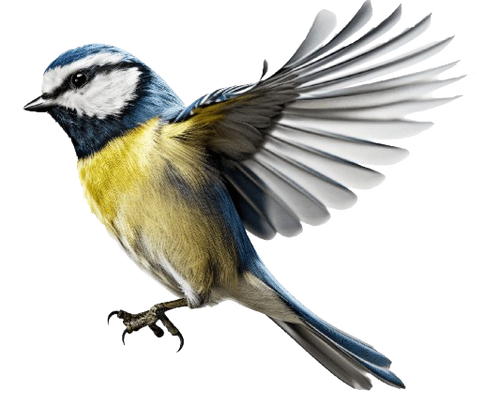
An upside down suet feeder is the design that addresses both problems at once, because the cake sits behind mesh on the underside and can only be reached by birds willing to hang beneath it. Starlings generally will not adopt that position, and squirrels cannot hold it long enough to chew through. Where squirrels are the heavier problem and starlings secondary, a cage barrier or a weight mechanism handles that side more completely.
Why do starlings and squirrels take over a suet feeder?
An open suet cage gives both animals an easy upright grip on a high fat food source. European starlings arrive in flocks and can empty a cake in a single visit, and squirrels hang from a standard cage and chew at the mesh with nothing in the way.
The ordinary wire cage has no mechanism that distinguishes between visitors. Every bird and mammal able to perch or cling at the side of the cage reaches the suet equally well, which means the feeder design is doing nothing to sort out the intended species.
Suet is calorie dense, so whichever animals find it first tend to return daily. Managing access is therefore a question of feeder geometry rather than of refilling more often.
How does an upside down design keep starlings off?
Upside down feeders work by requiring a feeding position that starlings generally avoid. The suet faces the ground behind a mesh panel, so reaching it means hanging beneath the feeder rather than perching at its side.
The species that handle that position comfortably are the clinging birds:
- Woodpeckers, which grip bark vertically as a matter of course
- Nuthatches, which routinely move head down along trunks
- Chickadees, which feed acrobatically at the ends of branches
- Titmice, which share the same clinging habit
The exclusion is strong rather than absolute. Product listings for this design describe the majority of starlings and other large birds as unable to feed upside down, which is a more accurate expectation than complete exclusion.
Which upside down suet feeder names both starlings and squirrels?
One suet feeder in the Urban Nature Store range names both animals in its own description. Upside down feeding is the mechanism behind Pine Bush Home & Garden's upside down suet cake feeder ($28.95 CAD), whose listing states the design helps deter squirrels and starlings while woodpeckers, nuthatches and chickadees feed comfortably.
Capacity is one standard sized cake, and nut, pure or flavoured suet all fit. A hanging wire comes with it, so no additional hardware is needed to put it up.
What converts an existing suet cage into a starling resistant one?
A cage cover converts a feeder already in use rather than replacing it. Where a top loading suet or seed cage is already hanging, Songbird Essentials makes a suet cage cover ($13.95 CAD) that slides over it, leaving chickadees, nuthatches and woodpeckers able to fly in upside down while the majority of starlings and other large birds are not.
One detail matters at the point of ordering. Listed on the suet cage cover page is a note that the kit does not include the wire cover or chain, so an existing cage feeder has to be on hand already.
Which feeders exclude squirrels through a cage or a weight mechanism?
Squirrel exclusion runs through either an outer cage or a weight setting, and the two approaches differ in price and in what else they keep out. Cage exclusion is the simpler of the two, used on the Stokes squirrel proof caged suet feeder ($56.95 CAD), which holds two suet or small bird seed cakes behind a double locking closure system and is described as keeping squirrels and large birds out.
Weight based exclusion carries the longer guarantee. Developed in Knowlton, Quebec by Brome Bird Care, the weight adjustable suet feeder ($125.95 CAD) holds two cakes, carries a lifetime warranty, and uses a larger opening that accommodates hairy and red bellied woodpeckers.
The practical difference sits in what each listing claims. Large birds appear alongside squirrels in the Stokes squirrel proof caged suet feeder description, which covers the starling problem as well, while the weight adjustable suet feeder listing addresses squirrels without referring to starlings.
What other upside down suet feeders suit different materials?
Material is the main point of difference among the remaining upside down options. Cedar resists insects and rot, which is the basis of the Nature's Way cedar upside down feeder ($26.95 CAD), built with powder coated steel mesh and stainless steel screws, measuring 3 inches high by 6.75 wide by 7.25 deep, and carrying a three year warranty. All woodpeckers, titmice, chickadees and nuthatches appear on that listing as the birds it serves.
Recycled plastic is the alternative where frequent cleaning matters. Standard size suet or seed cakes fit the Songbird Essentials recycled plastic upside down feeder ($35.95 CAD), whose listing states that only birds able to cling and eat upside down can use it and names starlings and grackles among the visitors it keeps away.
Where should a starling resistant suet feeder be placed?
Placement decides whether the design gets a chance to work. These positioning points apply regardless of which model goes up:
- Hang the feeder clear of any horizontal surface a squirrel can launch from, since a feeder reachable by jump makes the exclusion mechanism irrelevant.
- Keep it away from fence tops, deck rails and low branches, which all function as launch platforms.
- Position it near cover such as a shrub or tree line, so clinging birds have a staging point before approaching.
- Mount it where the underside is visible from a window, because feeding on an upside down design happens beneath the feeder rather than at its face.
- Allow space underneath for fallen fragments, which otherwise accumulate where ground feeders gather.
Frequently Asked Questions
Can starlings learn to feed upside down over time?
Some can. Product listings for this design describe the majority of starlings and other large birds as unable to manage the position, which leaves room for individual birds that work it out. An upside down design should be expected to reduce starling pressure substantially rather than end it outright.
Does a suet feeder need a roof?
It helps. A roof keeps rain off the cake and slows the rate at which suet softens and crumbles. The upside down orientation shelters the cake on its own as well, since the mesh faces the ground rather than the sky.
Will an upside down feeder also exclude grackles?
Yes, usually. Grackles lack the clinging habit the design requires, and the Songbird Essentials recycled plastic upside down feeder names starlings and grackles together among the birds it keeps away. Blue jays are not named on any of these listings.
Is there a suet product that discourages squirrels directly?
Yes. Hot pepper formulations are sold for that purpose, and C&S lists corn, roasted peanuts, rendered beef suet, oats, red pepper and soy oil among the ingredients in its hot pepper suet nuggets. Nuggets suit birds that do not cling, so they go in a platform or nugget feeder or mix into seed rather than sitting in a suet cage.
How many suet cakes should a feeder hold?
Match capacity to how fast the cake disappears. Single cake designs suit a yard with light traffic, while the two cake capacity of the Stokes squirrel proof caged suet feeder reduces refill frequency where a resident woodpecker pair visits daily.